
By Matthew Armitage
This is the first in a series of articles exploring how people used Britain’s rivers, lakes and coastal waters throughout history. Beginning with the Mesolithic, which started around 12,000 years ago and lasted until approximately 4000 BCE, the series follows the archaeological evidence for boats and water travel, looking at what has survived and what it can tell us about the people who lived here.
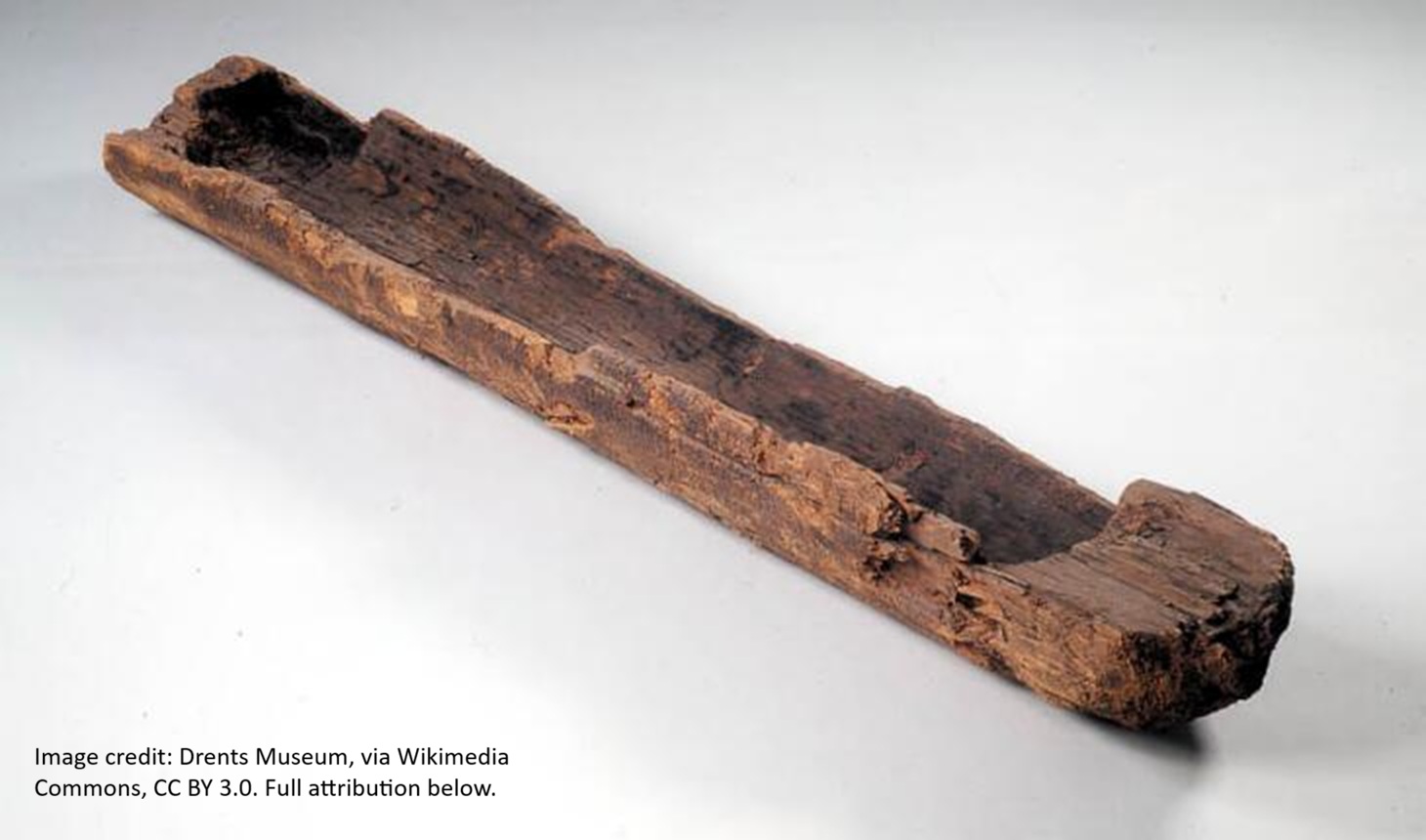
In 1955, a hollowed-out tree trunk was uncovered during road construction near the village of Pesse in the Netherlands. It proved to be something extraordinary: a wooden canoe made around 10,000 years ago, the oldest surviving boat yet discovered.
Someone had carefully hollowed out a pine tree trunk to make a small vessel. We do not know who made it or where it travelled, but the discovery shows that people in northern Europe were building wooden boats thousands of years before farming arrived.
If people were making boats in the Netherlands at this time, were they also travelling along the rivers and lakes of Britain?
The last Ice Age had ended, and Britain was becoming warmer. Trees were spreading across the countryside, gradually replacing much of the open landscape with woodland. Rivers flowed through valleys, while lakes and marshes occupied areas that are now dry land.
Britain was changing around its edges too. Much of the southern North Sea was still land, connecting Britain with continental Europe. As sea levels rose, this low-lying country was gradually flooded. Over thousands of years, the coastline changed as the remaining land connections with continental Europe disappeared beneath the sea.
For the people living through these changes, rivers and lakes were familiar parts of everyday life. They provided fish and attracted animals, while their shores offered places to camp. People could follow waterways on foot, but a boat might have allowed them to cross stretches of water, reach fishing grounds or carry belongings between places.
As woodland became more extensive, travelling overland with heavy loads may have become difficult in some areas. A river could offer another route, although shallow water, fallen trees and other obstacles would have made some stretches difficult to navigate.
One place where we can begin to understand this world is Star Carr, near Scarborough in North Yorkshire.
Today, the site lies beneath farmland. Around 11,000 years ago, however, it stood beside a large lake known as Lake Flixton. People visited its shores repeatedly over hundreds of years, leaving behind remarkable traces of their lives.
Archaeologists have recovered stone tools and animal bones, but some of the most important discoveries were made from wood.
Normally, wood from this period would have disappeared through decay. At Star Carr, the wet ground preserved thousands of pieces, allowing archaeologists to study how people worked with timber.
They found wooden structures along the lake edge and evidence of large pieces of wood being shaped with stone tools. There were also signs of vegetation being cleared and fire being used in the surrounding landscape.
These discoveries reveal people who understood their environment and knew how to make use of the materials around them. They returned to familiar places, worked timber and built structures beside the water.
Among the objects recovered during excavations led by archaeologist Grahame Clark in the middle of the twentieth century was a piece of wood that became known as the Star Carr paddle.
Its shape suggested that it might once have been used to propel a boat across the lake. The possibility was exciting, because a paddle would provide a direct connection between the people living at Star Carr and travel on the water.
Later research has questioned that interpretation. The object may instead have been used in preparing plants. No boat has been discovered at the site, so we cannot confidently identify it as a paddle.
Nevertheless, the woodworking evidence shows that Mesolithic people in Britain possessed skills that would have been useful in making wooden boats.
The Pesse canoe provides a useful comparison.
Its narrow shape initially raised doubts about whether it could have worked as a boat. In 2001, a replica was made and tested on water. It floated and could be paddled successfully.
The experiment demonstrated that such a vessel could function, even if it could not reveal how the original had been used.
Making it would have required considerable skill. Someone had to choose a suitable tree, shape the timber and remove enough wood from the centre to create a hollow vessel without weakening its sides. Working with stone tools, this would have taken time and patience.
The finished canoe was small, but it offered something valuable: a way of moving across water without having to swim or find a crossing.
Other discoveries show that Mesolithic boatbuilding developed further.
At Tybrind Vig, off the coast of Denmark, archaeologists working on a submerged prehistoric site discovered the remains of wooden boats and paddles. One vessel was approximately nine and a half metres long, considerably larger than the canoe from Pesse.
These boats belonged to a later part of the Mesolithic, but they demonstrate that people in northern Europe could construct substantial wooden craft. The surviving paddles also show how such boats were propelled.
We cannot assume that people in Britain used exactly the same designs, but the knowledge needed to make and use boats existed in the wider region during the Mesolithic.
There are also clues from Britain that people were moving across coastal waters.
On the Isle of Rùm, off western Scotland, Mesolithic people worked a distinctive stone known as bloodstone, using it to make tools. Artefacts made from Rùm bloodstone have also been found elsewhere in western Scotland.
The stone had travelled beyond the island. Whether people collected it themselves or obtained it through contact with other groups is less clear.
The changing coastline complicates the picture. Some places that are islands today were connected to larger areas of land at different times. Establishing when particular sea crossings became necessary is an important part of understanding these discoveries.
Even so, the evidence points towards people who knew the coastal landscape and maintained connections between different places. Boats would have provided one way of making journeys that required crossing water.
What might these journeys have been like?
A small canoe could have allowed someone to reach fishing grounds on a lake or cross a river where there was no convenient ford. A larger boat might have carried several people and their belongings along sheltered coastal waters.
We cannot reconstruct these journeys from direct British evidence, but the surviving boats from northern Europe show that such travel was possible.
The absence of surviving Mesolithic boats in Britain is not particularly surprising. Wood decays, and many former lakeshores and coastal settlements now lie beneath water or have been altered by later changes to the landscape.
The Pesse canoe survived because it was buried in conditions that protected the timber. At Star Carr, waterlogged ground preserved wooden objects that would normally have vanished. Without those unusual circumstances, much of what we know about Mesolithic woodworking would have been lost.
Archaeology gives us only a small part of the material world in which people lived. Stone tools survive readily, but objects made from wood and other organic materials are far less likely to remain.
The people of Mesolithic Britain lived in a country shaped by water. They returned to lakeshores, gathered food from wetlands and moved through a landscape that was changing around them.
We have yet to discover a securely identified Mesolithic boat in Britain. But the Pesse canoe, the discoveries at Tybrind Vig and the woodworking evidence from Star Carr show that boats were already part of life in northern Europe.
Britain’s rivers and lakes were places where people lived and found food, and they may also have provided routes through the countryside.
Thousands of years before the first roads or canals, Mesolithic communities were already living beside these waters. How they travelled upon them remains one of the most intriguing questions about their lives.
Sources and Further Reading
- Drents Museum. The Pesse Canoe. Discovery, dating and replica experiment. https://drentsmuseum.nl/collectie/boomstamkano-van-pesse
- Milner, N., Conneller, C. and Taylor, B. (eds), 2018. Star Carr, Volumes 1 and 2. White Rose University Press. https://doi.org/10.22599/book1 https://doi.org/10.22599/book2
- Bamforth, M. Woodworking Technology. University of York. Research on Mesolithic woodworking and the possible Star Carr paddle. https://etheses.whiterose.ac.uk/id/eprint/20569/1/Bamforth%20MA%20by%20research.pdf
- Bailey, G., Andersen, S. H. and Maarleveld, T. J., 2020. Denmark: Mesolithic Coastal Landscapes Submerged. Including Tybrind Vig. https://doi.org/10.1007/978-3-030-37367-2_3
- Scottish Archaeological Research Framework. Transport and Movement. Including Rùm bloodstone. https://scarf.scot/regional/higharf/palaeolithic-and-mesolithic/4-7-transport-and-movement/
Image Credit
Cover image: The Pesse canoe, Drents Museum, Assen, Netherlands. Photograph via Wikimedia Commons, CC BY 3.0.
Source: https://commons.wikimedia.org/wiki/File:Boomstamkano_van_Pesse,_Drents_Museum,_1955-VIII-2.jpg
